The impossible Dome: how Brunelleschi closed the sky over Florence
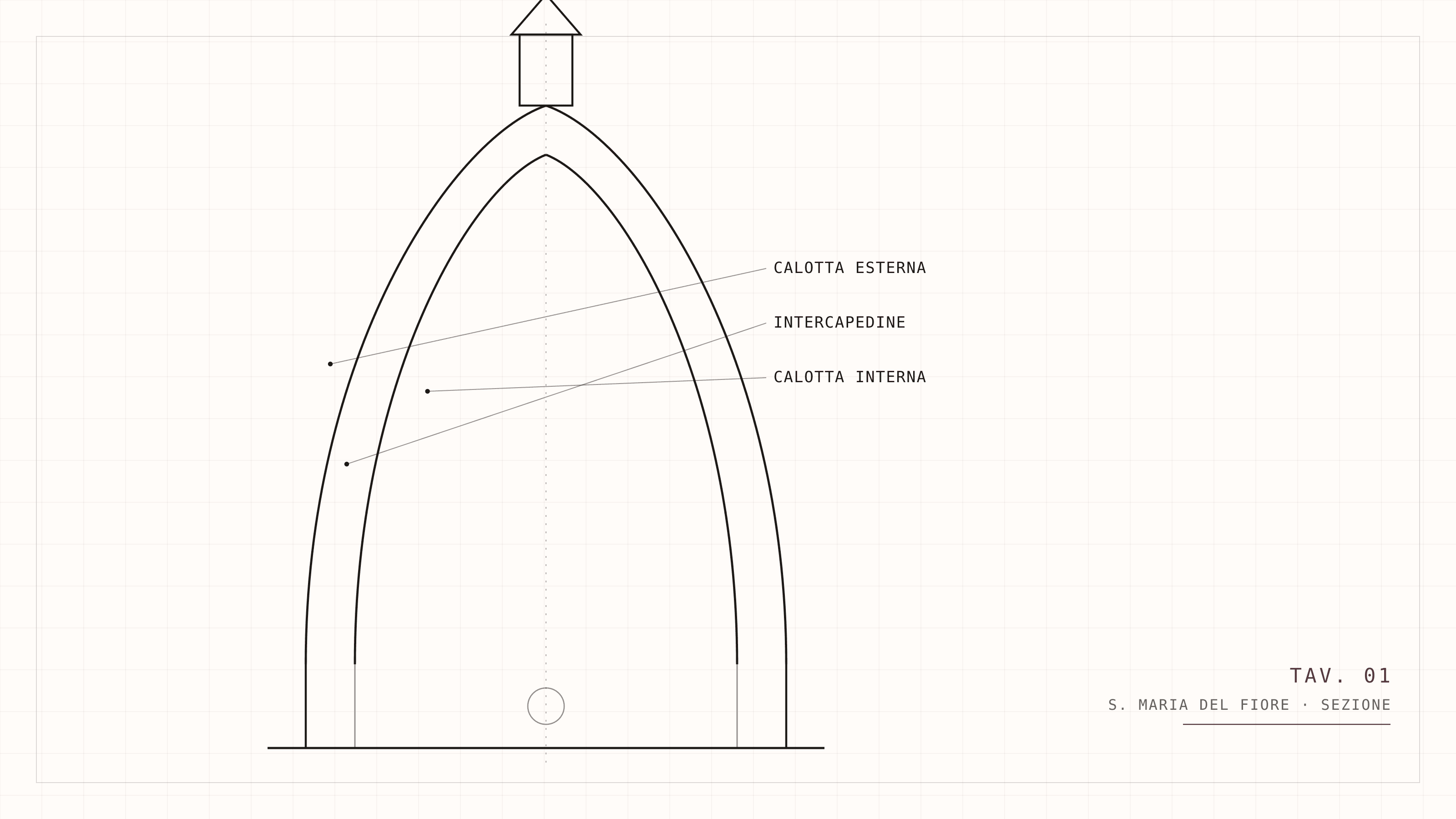
For more than a century nobody knew how to cover the crossing of Santa Maria del Fiore. Then a goldsmith with no title proposed building without centring: the story of a double shell and of a course of bricks that closes on itself.
There is a moment, climbing between the two shells of the Dome, when you realise that the building is not what you see from outside: it is what lies within its thickness. Between the intrados we look up at from the nave and the red profile that dominates Florence runs a cavity — a staircase, a shaft, a masonry machine wide enough to walk through standing up. That is where the problem lives, and that is where the solution lives.
When, in 1418, the Opera del Duomo announced the competition to roof the crossing, the octagonal drum had been standing for decades and nobody knew how to cover it. The span to be bridged — almost forty-five metres — was too great for the timber centring on which vaults had always been built. There were no trees that long; and even if there had been, no formwork would have carried the weight of the masonry up to the crown.
The impossible problem
Building a vault normally means first building its negative: a timber centring that holds up the voussoirs until the mortar sets and the arch closes. Once the centring is taken away, the arch “settles” and stands on its own. But for a dome of that size the centring would itself have become the impossible work — an upturned forest hanging in the void, harder to build than the dome itself.
Filippo Brunelleschi — a goldsmith, with no title of architect — proposed the unthinkable: to build without centring. The committee took him for a madman, and for a while showed him the door. He was right. The answer was not a bigger machine but a different way of laying bricks.

The secret lies in the way the bricks are laid. The masonry does not rise in continuous horizontal courses, but in herringbone: at regular intervals a brick is set upright and locks the flat ones, stopping the still-fresh course from sliding inwards. Each ring of bricks closes on itself and becomes self-supporting the very moment it is laid. As it rises, the dome holds itself up — course after course, like a basket woven from the top.
The double shell
The second insight is structural before it is constructional. Brunelleschi did not build one dome, but two: a thick, load-bearing inner shell and a thinner outer one that protects it from the weather and draws its silhouette against the sky. Between the two runs the cavity, which lightens the whole and allows the work to be inspected from inside — it is the staircase by which people still climb to the lantern today.
Everything is governed by a geometry: the octagon. Eight webs, divided by eight stone ribs, taper upwards until they close around the eye of the lantern. It is a design that the building site had to turn into a rule for laying, web by web, because the inclination of the bricks changes continuously as you go up.

The profile works too. The arch is not a semicircle but a pointed arch — more vertical, more “taut” — which reduces the thrust that every dome discharges outwards. And at the top the lantern, far from being an ornament, has weight: it loads the crown of the webs and keeps them locked together, like a hand gripping the top of a bundle.
Brunelleschi did not build a dome: he built the way to build it.
A building site that is already a work of art
To lift stone, brick and marble to height, Brunelleschi designed the machines that did not yet exist: reversible hoists driven by oxen, a revolving crane at the top, even canteens up on the dome so that the masons would not lose hours climbing down and back up. The building site itself was an invention. The Dome, in this sense, is a treatise written in brick: every course explains how the one before it was laid.
[i]In brief
The Dome of Santa Maria del Fiore (1420–1436) is the largest masonry vault ever built. Octagonal plan, two shells, pointed profile, herringbone brickwork, no load-bearing centring. To build it, Brunelleschi also invented the site machinery.
What it tells us today
The lesson is not nostalgia. The Dome reminds us that innovation does not always come through a new material: here it comes through a new way of using the oldest one, brick. It reminds us that structure and building site are the same thought, and that load-bearing masonry — when it is understood — ages slowly and lets itself be repaired. That is why, today, any intervention on a work like this is first and foremost an act of conservation.
Notebook
Dated additions the author keeps making over time — notes, follow-ups, video or audio episodes — curated by the editors.
A note on herringbone
I add this after a visit between the two shells: the herringbone is not the same everywhere. Its spacing changes as you go up, because the inclination of the webs changes. It is a pattern that adapts, course by course. I will keep noting here the variations I come across.
On the word “impossible”
Rereading the documents of the 1418 competition: the word that keeps coming back is not “difficult”, it is “impossible”. It is worth remembering — innovation, here, was not a new material but a new way of using the oldest one.